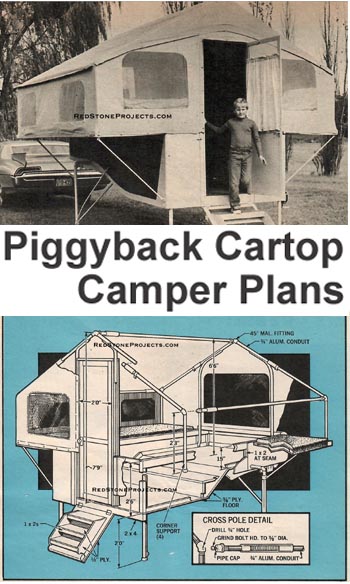
| IF YOU'VE always thought that you needed a pickup truck
to tote your camping rig instead of towing it, take a look at this idea.
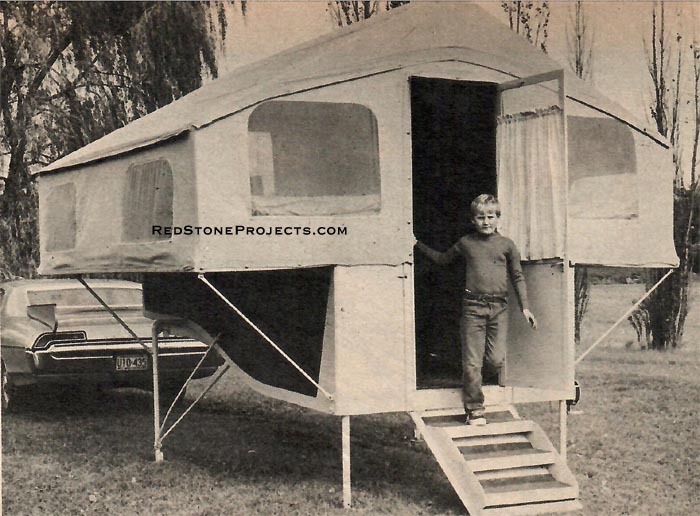
It's a camper that's easily carried on the top of just about any recent
model American sedan.
Lower the legs, unfasten the mounting brackets and you
drive your car out from under it. Total weight is about 600 lbs., including
bunks, table, canvas and carpeting.
Soft wood - clear white fir, white pine and exterior fir
plywood - was used throughout to keep weight to a minimum. The first part
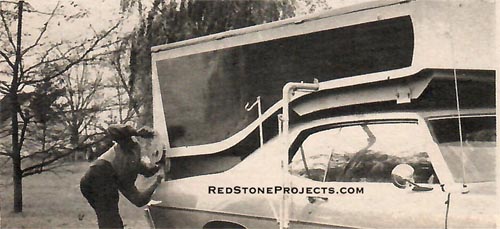
of the construction is done right on the car. Cardboard patterns for the
sides are cut to the shape of the rain gutters, then duplicated in 1/4-inch.
exterior plywood.
Measure the distance between the gutters at three different
points (the gutters do not necessarily run parallel) and make three spreaders,
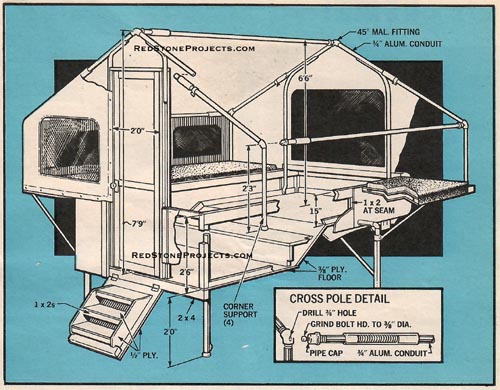
as shown in the drawings under the forward section and marked 2x4s. At
least one spreader should be cut to curve of the roof to stabilize the
side pieces. (Our drawing shows the center spreader cut on a curve.)
Follow the same procedure for the trunk adapter. A single
spreader (marked 2x4) is used and is mounted clear of the trunk cover.
The space between the trunk cover and the body is about 1/8-inch. L-shape
plates (marked 14-gauge steel) are bolted onto the rain gutter on either
side of the trunk. Make sure the trunk cover clears these plates when opening.
Install a 3/8-inch x 3/4-inch foam-rubber strip on the top and bottom edges
of the adapter, then fasten adapter to L-plates.
Set roof adapter into place and proceed to lay the plywood
floor, 1-inch x 2-inch base strip, uprights and the top rail. Using 4x8-ft.
sheets of 1/4-inch exterior plywood, cut the first side piece starting
from the rear. Cut the bottom edge to conform to profile of car and lower
than the camper floor to hide cables and pulleys. Finish the side pieces
and add the butt block at the seam. With sides mounted, the rig can be
removed from the car for finishing. |